ICDECT-2026
Call for Papers
The conference papers will cover disciplines of Computing, Engineering and Technology. The topics of interest include, but are not limited to the following:
ICDECT-2026
Conference Tracks
The conference shall have multiple tracks covering diverse disciplines of Data Engineering, Data Science, and Information & Communication Technology. Submissions are welcome in, but not limited to, the following tracks:
Track 1: Data Engineering & Architecture
This track focuses on the ingestion, storage, processing, and management of massive datasets.
Big Data Infrastructure: Distributed systems, cloud data warehouses, and data lakehouses.
Data Integration: Scalable ETL/ELT pipelines, data virtualization, and schema mapping.
Storage Systems: NoSQL, NewSQL, graph databases, and time-series repositories.
Stream Processing: Real-time data ingestion, event-driven architectures, and Kafka/Flink ecosystems.
Data Reliability: Data lineage tracking, quality monitoring, and automated schema migration.
Edge Computing Data: Decentralized storage management and lightweight edge databases.
Track 2: Advanced Data Analytics & Data Science
This track highlights the extraction of actionable insights using mathematical, statistical, and computational methods.
Predictive & Prescriptive Analytics: Statistical modeling, forecasting, and decision support systems.
Machine Learning & Deep Learning: Novel algorithms, neural network architectures, and pattern recognition.
Natural Language Processing (NLP): Large Language Models (LLMs), text mining, and sentiment analysis.
Computer Vision: Image processing, video analytics, and spatial data reasoning.
Big Data Mining: Graph analytics, social network analysis, and anomaly detection.
Explainable AI (XAI): Interpretability, fairness, and bias mitigation in analytics workflows.
Track 3: Information & Communication Technology (ICT) Foundations
This track covers the core infrastructure, networking, and hardware systems driving modern communication.
Next-Generation Networking: 5G/6G cellular architectures, software-defined networking (SDN), and Network Function Virtualization (NFV).
Internet of Things (IoT): Industrial IoT (IIoT), smart sensor networks, and M2M communication protocols.
Cloud & Grid Computing: Serverless architectures, virtualization, and hybrid cloud management.
Cybersecurity & Privacy: Cryptography, threat intelligence, network forensics, and Zero Trust architectures.
Embedded Systems: Cyber-physical systems, hardware-software co-design, and low-power ICT devices.
Signal Processing: Digital signal processing, wireless propagation, and cognitive radio networks.
Track 4: ICT Applications & Smart Technologies
This track explores how data and ICT converge to solve real-world problems across industries.
Smart Cities & Infrastructure: Intelligent Transportation Systems (ITS), smart grids, and urban computing.
Digital Health & Health Informatics: Electronic health records, telemedicine, and biomedical data analytics.
E-Governance & Digital Inclusion: Public sector ICT deployment, digital identity systems, and civic tech.
FinTech & Blockchain: Decentralized finance (DeFi), smart contracts, and secure ledger analytics.
EduTech & Smart Learning: Virtual classrooms, adaptive learning systems, and learning analytics.
Industry 4.0: Digital twins, automated supply chains, and smart manufacturing lines.
Track 5: Data Governance, Ethics & Emerging Trends
This track addresses the structural, legal, and futuristic paradigms of managing digital ecosystems.
Data Governance & Compliance: GDPR/CCPA alignment, metadata management, and data cataloging tools.
Quantum Computing: Quantum data structures, quantum machine learning, and post-quantum cryptography.
Green ICT & Sustainability: Energy-efficient data centers, sustainable computing, and carbon footprint tracking.
Data Democratization: Low-code/no-code analytics platforms and self-service BI architectures.
Human-Computer Interaction (HCI): Data visualization dashboards, AR/VR interfaces, and collaborative ICT tools.
Submitted papers must be original, unpublished, and not under consideration elsewhere. All manuscripts will undergo a rigorous peer review process, and accepted papers must be registered to be included in the final proceedings. All accepted and registered papers shall be published in SPRINGER SCOPUS indexed book series.
Submit Your PaperICDECT-2026
Abstracted and indexed in
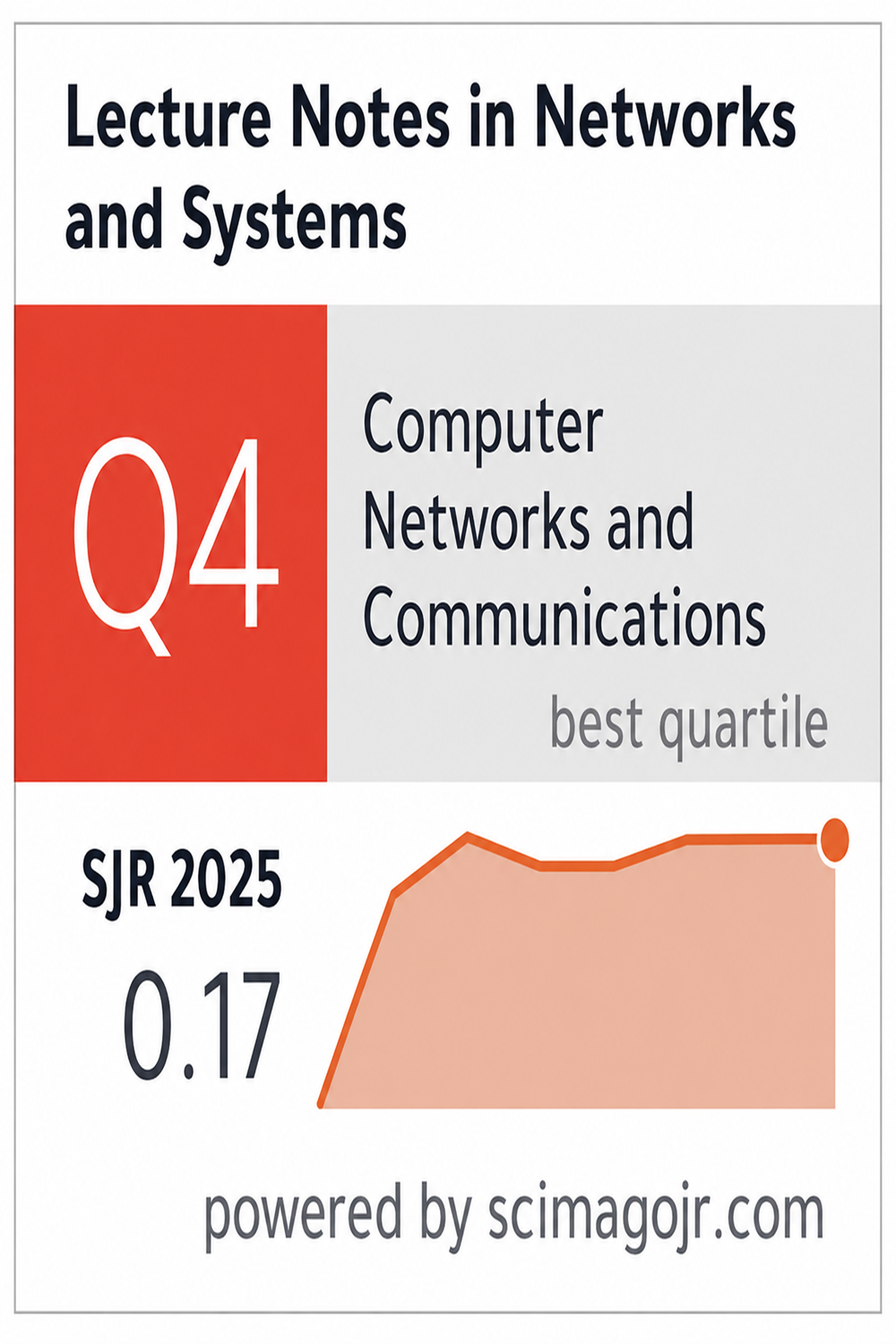
All accepted, registered and presented papers under this conference will be submitted to Springer, Lecture Notes in Networks and Systems Series.
The books of this series are submitted to
- SCOPUS
- SCImago
- DBLP
- EI Compendex
- INSPEC
- Japanese Science and Technology Agency (JST)
- zbMATH
- WTI AG